
Dry to the touch is not dry. A basement wall can feel fine and still read wet inside, and a floor that looks normal can hold water in the subfloor for weeks. Structural drying is the stage of water damage restoration in Toronto that decides whether a building really recovers or starts growing problems inside its walls. It follows extraction, and it is a matter of air, temperature and time, not just a fan pointed at a wet spot.
To the homeowner, a wet structure often looks like nothing at all: no puddle, but a musty smell, floorboards starting to cup, baseboards lifting off the wall, paint bubbling, a cold clammy feel in a room that was fine last week. Those are signs of water still sitting in the materials. Pull furniture and curtains back from the wet wall, keep the heat at a normal level, and do not wrap the area in plastic yourself, since sealed damp materials stay damp. If a fixture or outlet is wet, leave it off.
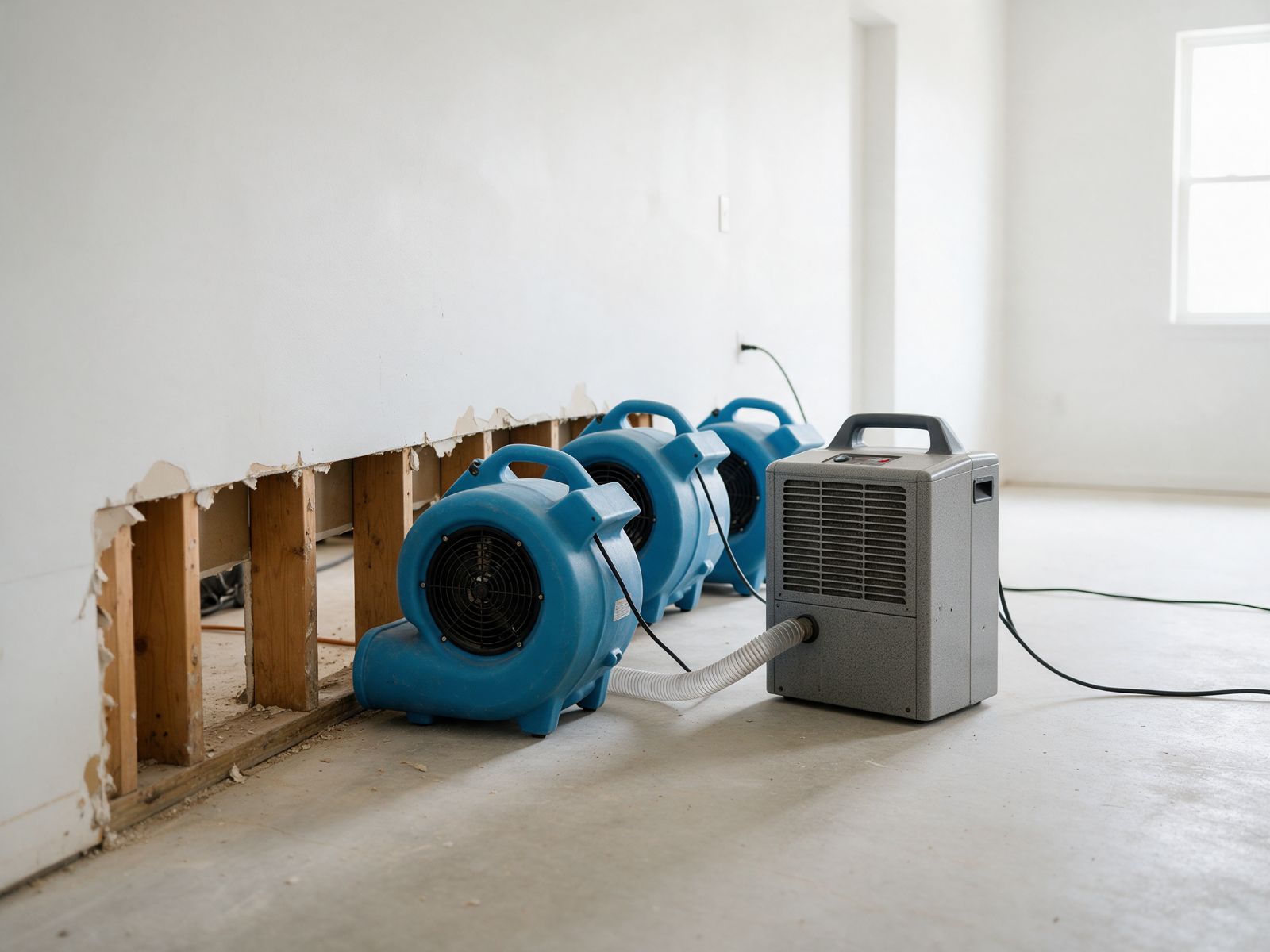
Fans alone fail because they only move wet air around. A box fan lifts moisture off a surface, but that moisture goes into the room air and settles back onto the coolest surfaces, which in a Toronto basement means concrete and framing. With no dehumidifier taking it out, the humidity climbs and drying stalls. A proper setup balances air movers pushing air across wet surfaces with low-grain refrigerant (LGR) dehumidifiers that pull the water out of the air and send it out of the building through a drain hose or pump.
Every drying job begins with a goal. We take readings from dry, unaffected areas of the same house as a reference, then set a target for each material so we know when it counts as dry. Drywall, wood framing, hardwood and concrete each dry at their own pace and read differently on the meter. We do not promise a number of days in advance. The materials tell us when they are done, and the equipment stays until the readings say so.
Equipment is checked and readings are logged every day. We record moisture content in drywall, framing and floors, plus the temperature and humidity of the room and of the air coming out of the dehumidifier. If a reading is not falling, we move the air movers, add or swap equipment, or lift baseboard and open a cavity to reach what the air cannot. Those daily logs and the photos form the record you can hand to your home insurance adjuster. We do not make promises about how any claim will turn out.
Concrete is slow. A poured slab and foundation wall hold water in their pores and release it gradually, so they dry over days or weeks, not hours. Wood framing at the base of a wet wall wicks water upward and can stay wet inside a stud cavity long after the face of the drywall feels dry. Sometimes the only way to dry framing is to take the drywall off or drill small relief holes at the bottom of the wall to get air moving through the cavity. Soaked insulation rarely dries back to anything useful, so it comes out.
The cost of structural drying follows the equipment and the days. How many square feet are wet, how many dehumidifiers and air movers the space needs, how many days they run, whether walls or flooring must be opened, and how deep the water went into concrete and framing. Tall ceilings and open-plan spaces need more capacity than a small bedroom, and a finished basement with several rooms needs more than a bare one. Drying a single wall is a smaller job than drying a whole floor. We explain the price on site before work starts.
Drying is urgent even when no water is standing. Wet drywall and framing left alone for more than a day or two can start to grow mould, and at that point a mould specialist, not us, takes over. Toronto's seasons change how we work. In winter the heated indoor air is dry, which helps, but cold basement concrete holds on to moisture. In humid July and August, opening windows only brings in more wet air, so we dry in a closed space with dehumidifiers and keep doors and windows shut.
From our crew: Do not judge dryness by feel. Press a moisture meter against the wall at several heights, from floor level upward, and check the bottom plate behind the baseboard. The wall can look dry at eye level and still be wet at the floor.
Structural drying usually follows Water Extraction and sits alongside Basement Flood Repair or Ceiling Water Damage Repair. Expect some noise and warm air from the equipment, a drain hose running to a sink or floor drain, and a rise in your power use while it runs. Do not unplug a unit to charge a phone. If you have water damage and nothing has been dried yet, call (226) 639-7972. We answer 24 hours a day, 7 days a week, across Toronto, Vaughan, Brampton, Oakville, Ajax and the rest of our service area.
Structural Drying Services We Offer
✓LGR Dehumidification
Low-grain refrigerant dehumidifiers pull water out of the air and out of the building through a drain hose or pump.
✓Air Mover Placement
Air movers are set at angles along walls and across floors so airflow reaches the wet materials.
✓Concrete and Framing Drying
Slabs, block walls and wood studs are dried to target readings, with cavities opened where air cannot reach.
✓Daily Moisture Monitoring
Readings are taken and logged every day so equipment is moved or removed based on numbers, not guesswork.
How it works
- 1
Take baseline readings
We read dry areas of the house for a reference, then map every wet wall, floor and ceiling with a moisture meter and thermal camera.
- 2
Set the drying goals
Each material gets a target reading. Walls or floors that cannot dry in place are opened so air can reach the studs and subfloor. We note them down so the goals are clear from day one.
- 3
Run the equipment
LGR dehumidifiers and air movers go in, the space is closed, and drain hoses are run so the water leaves the building. Doors and windows stay shut while it runs.
- 4
Log and remove
Readings are logged daily and equipment is adjusted. When materials reach dry standard, the equipment goes and you get the record. Nothing is removed on a guess.
Pricing
Cost follows the square footage that is wet, the amount of equipment, how many days it runs and whether walls or floors need to be opened. The price is explained on site before work starts.