
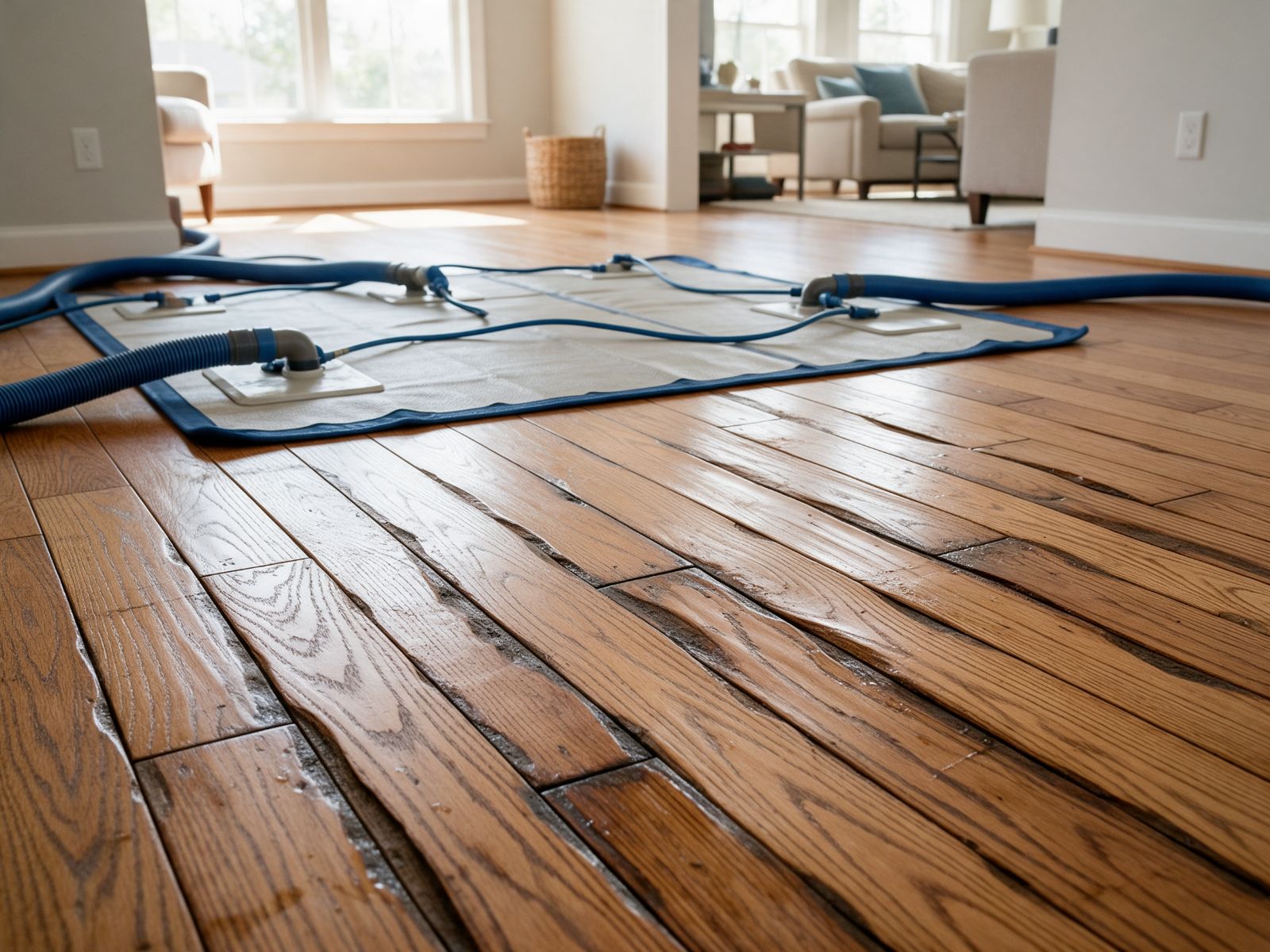
The first sign is often at the edges of the boards. They rise a little, so the middle of each plank sits lower and you can feel a shallow wave under your socks. Sometimes the boards squeak, gaps open between them, or a dark stain appears around a seam. That is hardwood absorbing water, and it does it slowly and quietly. A floor that looks only slightly wavy the morning after a leak may be holding a lot of moisture in the wood and in the subfloor underneath.
Speed matters more here than almost anywhere else in the house, so start with the basics. Stop the source, and if it is a pipe, shut the main water valve. Mop or towel up any standing water, but do not run a heater or point a hot hair dryer at the floor, and do not sand or pull boards yourself. Fast heat dries the surface and splits the wood. Lift rugs, mats and furniture off the floor so air reaches the boards, and photograph the damage before anything moves.
There are two shapes of damage and they tell us different things. Cupping is when board edges rise higher than the centre, which usually means water got in from below or moisture is sitting underneath. Crowning is the opposite, with the centre higher than the edges, and it often shows up after a cupped floor was sanded too early or dried too fast. A floor can also buckle, where boards lift off the subfloor altogether. Buckled boards almost always have to come out.
Solid and engineered flooring react differently. Solid hardwood is one piece of oak or maple, swells more, but can often be dried and then refinished if it has not gone too far. Engineered flooring has a thin wear layer glued to plywood or fibreboard layers, and once the glue lines or the core have swelled it rarely goes flat again. We find out which you have by checking an edge or a vent opening, and then we measure it with a pin meter instead of guessing.
The saving method is controlled drying. We bring in drying mats, which pull moisture upward through the boards under negative pressure, and run them with low-grain dehumidifiers and air movers. We drill nothing unless it is needed. Readings go in a log every day, on boards and on the subfloor, because the surface can read dry while the plywood or planks underneath stay wet. Many floors dry in several days. We stop when the meter shows the wood has returned to a normal range, not when it feels dry.
The subfloor decides the outcome. If water has soaked into plywood, plank subfloor or the joists below, the boards above cannot stay flat no matter how well they are dried. We check the underside where we can, such as from an unfinished basement ceiling, and we compare readings between boards and subfloor. If the subfloor is wet, the drying has to run longer, and when the subfloor has gone soft or begun to delaminate, boards and subfloor both come out in that area.
Some boards have to come out, and we tell you which ones and why. Boards that are buckled, split, black at the seams or still cupped after drying are removed, and sound boards around them are kept where they can be. Laminate is a different story. Laminate is a fibreboard core with a printed layer, and once water reaches the edges it swells and does not shrink back, so laminate usually cannot be saved. Vinyl plank over a wet floor often has to lift too, because it traps moisture underneath.
The cost depends on the floor type, how many square feet are wet, how long the water sat, whether the subfloor is affected, how many days the drying mats and equipment run, and whether sections have to be removed and replaced. Refinishing or matching new boards to old is its own scope and is discussed separately. We explain the price on site before work starts, once the readings show whether your floor is a drying job or a replacement job.
Call quickly if boards are lifting off the subfloor, if water has run under a baseboard and across a large section, or if the leak sat for more than a day or two. In older Toronto houses, solid oak is often laid over diagonal plank subfloor on joists above a damp basement, which gives moisture a path from below, and in condo towers engineered flooring over a concrete slab can hold water at the edges where it meets the wall.
From our crew: Do not judge a floor by how it feels on the surface. Put the meter on the boards and on the subfloor, and take readings again the next day. A floor that rebounds after you think it is dry usually still has wet plywood underneath.
For wet hardwood in Toronto or the GTA, call us at (226) 639-7972, any hour of any day. We take the standing water off first, lay drying mats, and read the boards and the subfloor each day, so the choice to keep or replace them rests on numbers and not on how the floor looks. Tell us on the phone whether the floor is solid or engineered and what the water came from, and we will tell you what to do with it until we arrive.
Hardwood Floor Water Damage Services We Offer
✓Drying Mat Systems
Mats pull moisture up through the boards and are run with dehumidifiers until the readings return to a normal range.
✓Subfloor Moisture Checks
Readings below the boards tell us whether the plywood or planks are wet and how long the drying has to run.
✓Board Removal
Buckled, split or unsalvageable boards are taken out and sound boards around them are kept where possible.
✓Engineered and Laminate Assessment
We check the core and edges to tell you whether the floor can be dried or whether it has to be replaced.
How it works
- 1
Measure the floor
A pin meter gives readings on the boards and on the subfloor, and we photograph the cupping, crowning, gaps and stains before any drying equipment goes down on the floor.
- 2
Remove standing water
Extractors lift water off the surface and from under baseboards, so the drying equipment works on the wood itself and not on a layer of standing water above it.
- 3
Set up drying
Drying mats, dehumidifiers and air movers go in, and we take readings every day on both the boards and the subfloor until the numbers return to a normal range.
- 4
Decide and finish
When readings level out we tell you which boards stay and which come out, and we explain what any replacement or refinishing would involve before anything is done.
Pricing
Price depends on the flooring type, how many square feet are wet, how long the water sat, whether the subfloor is wet and how many days of drying equipment run. The price is explained on site before work starts.